


The Federal Research Support Fund (RSF), provided by the Government of Canada, assists Canadian postsecondary institutions with the costs associated with managing their research enterprise, helping them to maintain a world-class research environment.
When people think about the cost of research, for many what comes to mind are things like specialized equipment, salaries of trainees (graduate students, post-doctoral fellows and research assistants), travel costs, and so forth. These are the “direct” costs of research – budgeted expenditures for undertaking a specific research project. Less likely to be associated with the costs of research, however, are things like maintenance of the building where the researcher works, the electricity used to power the specialized equipment, or the staff that provide support for research funding applications/agreements, oversight and compliance. These “indirect” costs are the hidden costs of research; the real dollars incurred by the University, or affiliated institutions, to support research activities. It can be difficult to assign these costs to specific projects since these necessities for conducting research are often shared. U of T has established a Research Administration Policy that provides a more specific definition of “direct” and “indirect” costs.
The RSF program provides partial support to universities and their affiliates for the indirect costs of research associated with eligible Tri-Agency (i.e., NSERC, SSHRC, CIHR) awards. This funding helps institutions to address hidden costs of research such as lighting, heating, and the increasingly complex oversight and compliance requirements that ensure the safety of researchers, as well as their human and animal subjects. This support allows researchers to concentrate on conducting cutting-edge research.
According to its website, the Research Support Fund assists Canadian postsecondary institutions with the costs associated with managing their research enterprise, helping them to maintain a world-class research environment. Grants can be used to do any of the following.
- Maintain modern labs and equipment
- Provide access to up-to-date knowledge resources
- Provide research management and administrative support
- Meet regulatory and ethical standards
- Transfer knowledge from academia to the private, public and not-for-profit sectors, and, in so doing, helps to make Canada a world leader in research and development
The University of Toronto (U of T) is a large, complex institution, comprising three campuses, 18 Faculties/Divisions, 88 Departments, and 179 extra departmental units. Eligible tri-agency funded research conducted at the following 14 affiliated hospitals is counted in the calculation of RSF funding for the University's ‘system’.
- Baycrest Health Sciences
- Centre for Addiction and Mental Health (CAMH)
- Holland Bloorview Kids Rehabilitation Hospital
- Hospital for Sick Children (SickKids)
- Humber River Hospital
- Michael Garron Hospital (Toronto East Health Network)
- North York General Hospital
- Scarborough Health Network
- Sinai Health System (Mount Sinai Hospital)
- Sunnybrook Health Sciences Centre
- Trillium Health Partners
- Unity Health Toronto
- University Health Network
- Women's College Hospital
See the comprehensive list of all affiliated institutions (including primary, sub- and sub-sub-affiliates).
For 2026-27, the University and its affiliates will notionally receive a total grant of $63,266,993, consisting of the following.
- Research Support Fund - $42,124,235.00
- Incremental Project Grant (IPG) - $18,357,594.00
- Research Security - $3,949,762.00
The projected allocations for RSF expense categories reflect the actuals in the most recent year for which financial reporting is complete, at the time of the RSF application. (as noted in the graph below).
Each year, the University’s Planning and Budget Office undertakes a detailed analysis of the institutional costs associated with supporting the University’s research enterprise. Although the RSF provides critical indirect costs support for research funded through selected tri-agency programs, a significant gap remains between the true indirect cost of tri-agency funded research relative to direct costs. Our actual on campus indirect cost rate was 59.3% in 2025-26. The rate provided through the RSF program in 2025-26 was 20.2% when including the IPG and Research Security grants - the lowest such rate of any university in Canada. The resulting gap (39.1%) constrains our potential as an internationally competitive research institution and requires the redirection of funds to indirect costs of research from other operations, including our teaching function.
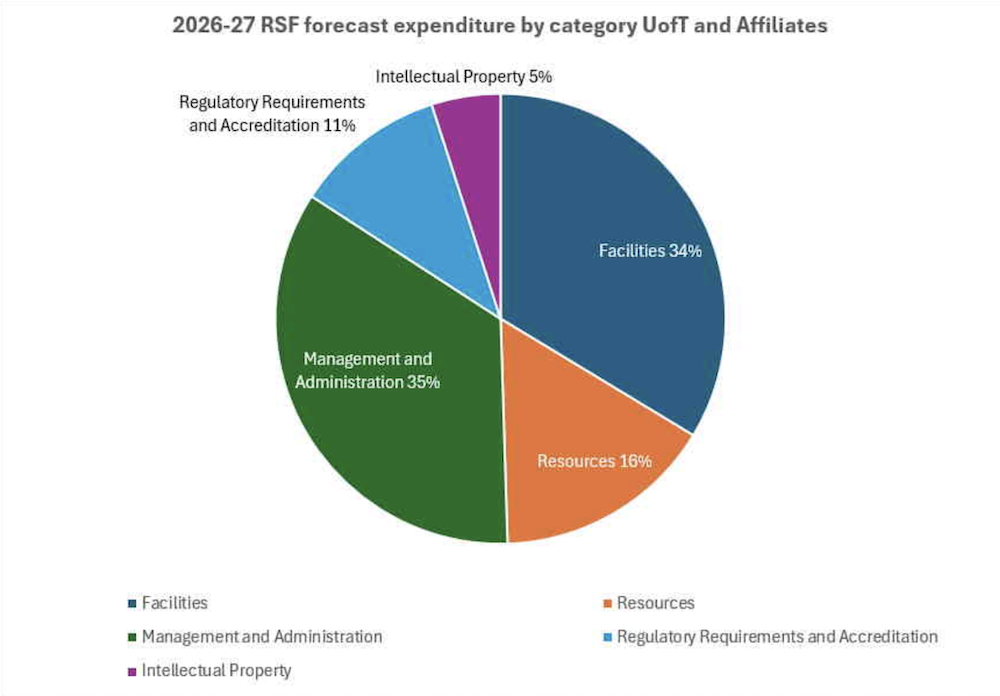
Annual University of Toronto Research Support Fund – Grant Amounts & Expenditures by Category
The RSF provides funding to Canadian postsecondary institutions to assist with the management of their research enterprise. RSF funds are allocated to five eligible expenditure categories, which include the following.
- Research facilities
- Research resources
- Management and administration of research enterprise
- Regulatory requirements and accreditation
- Intellectual property & knowledge mobilization
The Research Support Fund: Building the Foundation for Research Excellence
The RSF plays a critical role in sustaining the research enterprise at U of T .and across its affiliated institutions. While RSF funding only covers a fraction of the true indirect costs of research, it provides essential support for the infrastructure and expertise that make world-class research possible.
These investments strengthen systems, services, and resources that researchers rely on, ensuring compliance, operational efficiency, and the capacity to compete successfully for external funding. The following wo examples show how RSF funding makes an impact.
Strengthening the Foundations of Research at Trillium Health Partners
In FY2025-26, Trillium Health Partners' (THP) Research Operations and Research & Innovation Finance portfolios continued to provide the critical infrastructure that supports and sustains the organization's growing research enterprise. These integrated supports help enable all Tri-Agency-funded research conducted under THP's auspices and have contributed to THP's recognition as one of Canada's Top 40 Research Hospitals for three consecutive years. Over the past three years, THP has experienced a 43% increase in research-funded activity, requiring significant growth and optimization of the administrative, financial, operational, and regulatory supports needed to manage an expanding portfolio.
Research Support Fund (RSF) resources helped strengthen this institutional capacity by partially supporting dedicated staff responsible for research administration, financial management, regulatory compliance, and operational oversight. RSF funding also helped offset the costs of core research resources that are shared across the research community and available to support investigators throughout the organization.
During FY2025-26, RSF funding also contributed to the development of an equity- and engagement-informed clinical trials strategy, enhancing THP's approach to improving access to clinical trials and supporting meaningful participation by diverse patient populations. Collectively, these investments in people, processes, and shared resources enabled THP to support 264 active studies across 30 hospital departments and collaborate with 80 external research partners during the year, strengthening the institution's capacity to deliver high-quality, impactful health research.
Enabling Discovery Through Advanced Neuroimaging Infrastructure
Research Support Fund (RSF) funding helped sustain operation of Baycrest's Magnetoencephalography (MEG) system, a unique and critical neuroimaging resource that enables researchers to study human brain function with exceptional temporal and spatial precision. By supporting the purchase of helium required for the operation of the MEG, RSF funding helped ensure continued access to this specialized infrastructure for researchers investigating hearing, vision, language, memory, and other cognitive processes that are affected by aging and neurological disease.
The MEG system is a cornerstone of Baycrest's research enterprise and has supported more than 150 peer-reviewed publications since 2001. In recent years, demand for the system has continued to grow. During the reporting period, the facility supported 13 active research projects led by eight principal investigators, including five Baycrest-led projects and three external collaborations. The system is also supporting new partnerships beyond academia, including an agreement with an industry partner to develop a screening tool for post-traumatic stress disorder (PTSD) and traumatic brain injury (TBI) in Canadian Armed Forces personnel returning from deployment.
Research conducted using the MEG system during the past year advanced understanding of short-term memory and language processing, visual perception, motor control, and the brain mechanisms underlying music-supported stroke rehabilitation. By maintaining access to this advanced research platform, RSF funding helped enable discovery, foster collaboration across institutions and sectors, and support the development of innovative approaches to understanding and improving brain health.
The RSF program requires eligible institutions to prepare institutional performance indicators for the upcoming year.
Additionally, the University is also responsible for reporting outcomes on a yearly basis. Please see U of T RSF 2025-26 Institutional Performance Objectives.
The Incremental Project Grants (IPG) was introduced in 2018-2019 to provide eligible institutions with additional support for projects that focus on the following four IPG priority areas.
- Innovation and commercialization activities
- Facilities renewal, including deferred maintenance
- Information resources, including digital resources, open access and databases
- Equity, diversity and faculty renewal (in the context of equity, diversity and inclusion)
For the FY 2026-27, the University’s notional allocation is $18,357,594 with the percentage of projects by the following eligible category as follows.
- Innovation and commercialization activities: 6.3%
- Facilities renewal, including deferred maintenance: 82.3%
- Information resources, including digital resources, open access and databases: 8.4%
- Equity, diversity and faculty renewal: 3.1%
For further detail, please see Institutional Performance Indicators for the upcoming year.
In addition, the University is responsible for reporting outcomes on a yearly basis. Please see the following for details.
Research security is categorized as a fifth priority area of the IPGs. These investments are aligned with the RSF’s objectives to help Canadian post-secondary institutions ensure their federally funded research projects are conducted in world-class facilities with the best equipment and administrative support available. By directing funds to specific investments and to annual or multiyear projects initiated by institutions, research security funding will help to build capacity within post-secondary institutions to identify, assess and mitigate the potential risks to research security.
For the FY2026-27 the University’s notional allocation is $3,949,762
For further detail, please see Institutional Performance Indicators for the upcoming year.
In addition, the University is responsible for reporting outcomes on a yearly basis. Please see the following for details.
- U of T RSF 2021-22 Institutional Performance Objectives
- U of T RSF 2022-23 Institutional Performance Objectives
- U of T RSF 2023-24 Institutional Performance Objectives
- U of T RSF 2024-25 Institutional Performance Objectives
- U of T RSF 2025-26 Institutional Performance Objectives
- Annual U of T RSF – Grant Amounts & Expenditures by Category
- U of T IPG 2021-22 Institutional Performance Objectives
- U of T IPG 2022-23 Institutional Performance Objectives
- U of T IPG 2023-24 Institutional Performance Objectives
- U of T IPG 2025-26 Institutional Performance Objectives
- 2023-2024 Research Security Fund Institutional Performance Objectives
- 2024-2025 Research Security Fund Institutional Performance Objectives
- 2025-2026 Research Security Fund Institutional Performance Objectives
- U of T Affiliated Organizations List - RSF
- Facilitate the preparation and submission of the application, dissemination of funds and collection of data for yearly reports

Staff